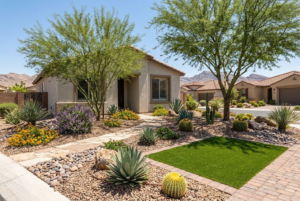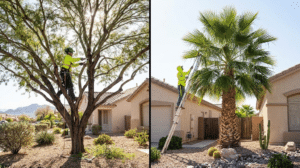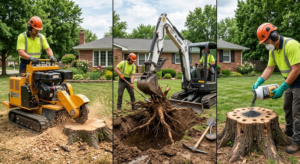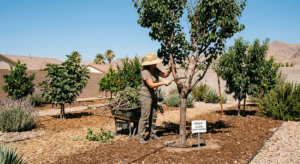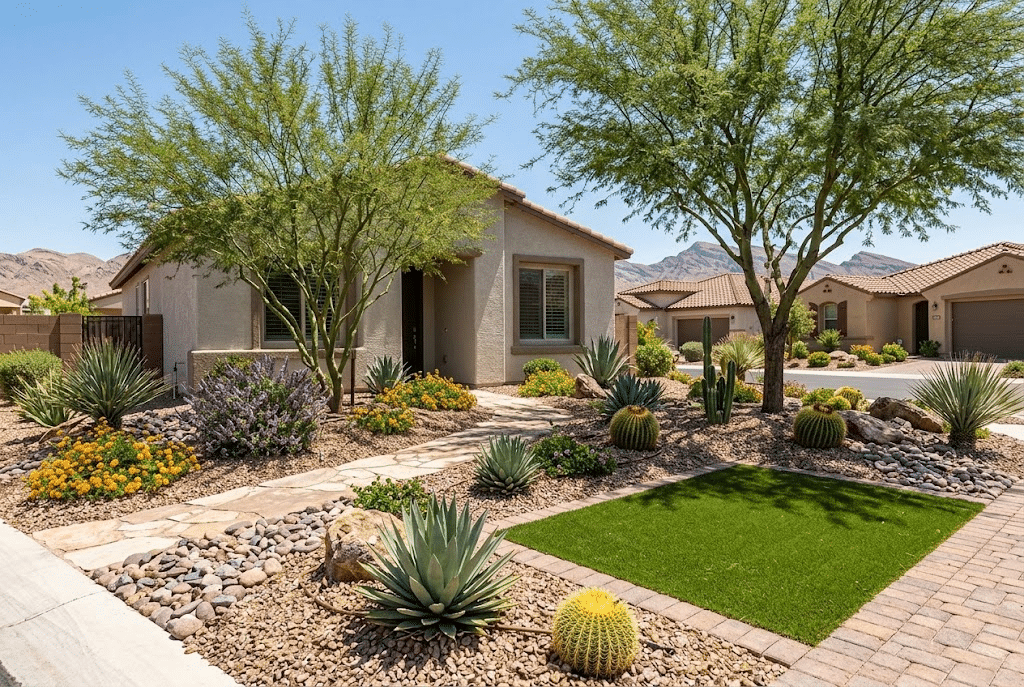

What are the best shade trees for a desert yard? The answer depends on root behavior, canopy density, and water demand, not just growth speed. The best shade trees for Las Vegas must survive alkaline soil, minimal rainfall, and heat that quietly kills most species that appear healthy in nurseries.
Las Vegas averages 294 sunny days per year and regularly exceeds 108°F in summer. At those temperatures, exposed soil loses moisture within hours and outdoor spaces become unusable by mid-morning.
Top Shade Trees for Las Vegas
Nine species consistently perform in Mojave conditions. Each is listed with the practical details that determine placement: growth rate, mature height, water needs, shade density, and trade-offs.
For projects in hot, dry yards, it helps to work with desert landscaping specialists who know which trees will thrive and how to place them for long-term success.
African Sumac
Growth Rate: Fast | Mature Height: 20–30 ft | Water Needs: Low | Shade Density: Dense, spreading canopy
Being the most widely planted shade tree in Las Vegas, African Sumac establishes quickly, holds its leaves year-round, and develops a broad canopy that blocks summer sun rather than filters it.
Pros: Fast canopy, dense year-round coverage, drought-tolerant once established.
Cons: Aggressive roots can lift sidewalks and damage buried pipes and irrigation lines.
Mesquite
Growth Rate: Moderate–Fast | Mature Height: 20–30 ft | Water Needs: Very Low | Shade Density: Light, filtered
Mesquite, native to the Mojave and nearly self-sufficient after establishment, is the right call when drought-tolerant landscaping is the primary goal. The canopy is filtered rather than dense, better for dappled coverage over a seating area than for blocking a west-facing wall.
Pros: Minimal water needs, strong native desert resilience.
Cons: Thorny varieties require careful placement, seasonal seed pod cleanup.
Palo Verde
Growth Rate: Moderate | Mature Height: 15–30 ft | Water Needs: Very Low | Shade Density: Light, filtered
The Palo Verde, one of the most resilient options for Las Vegas extreme heat, photosynthesizes through its green trunk even when it drops leaves during drought. The shade is airy, best for desert-aesthetic yards rather than heavy overhead coverage applications.
Pros: Extremely low water needs, distinctive desert character.
Cons: Brittle in high winds, limited shade density.
California Pepper Tree
Growth Rate: Fast | Mature Height: 25–40 ft | Water Needs: Low | Shade Density: Large, dense canopy
The California Pepper Tree spreads wide and establishes quickly. Keep it well away from pool equipment, irrigation mainlines, and flatwork. The root system earns its reputation for underground damage.
Pros: Large dense canopy, drought-tolerant after establishment.
Cons: Invasive roots damage buried infrastructure, messy berry production.
Fruitless Olive
Growth Rate: Slow–Moderate | Mature Height: 20–30 ft | Water Needs: Low | Shade Density: Dense, rounded canopy
Fruitless Olive is a fixture in Mediterranean-style yards across the Valley. It handles heat and low water well, develops a sculptural form over time, and works cleanly near patios and entry courtyards.
Pros: Attractive form, dense shade, low water, long-lived.
Cons: Pollen can trigger allergies, slower canopy development than fast-growing alternatives.
Holly Oak
Growth Rate: Moderate | Mature Height: 40–70 ft | Water Needs: Low–Medium | Shade Density: Dense evergreen canopy
Being one of the few large evergreen options that performs in Las Vegas, Holly Oak stays fully leafed year-round and becomes a significant privacy asset over time. That’s the upside. The tradeoff is irrigation; it asks more than true desert natives.
Pros: Year-round dense canopy, strong privacy screening, long-lived.
Cons: Higher water demands, requires consistent pruning.
Magnolia Tree
Growth Rate: Slow–Moderate | Mature Height: 20–60 ft | Water Needs: Medium | Shade Density: Dense, broad canopy
It needs more water and protection from afternoon exposure than most Las Vegas yards provide without active irrigation management. Magnolia Tree is not a low-maintenance choice and not right for most desert yards.
Pros: Striking flowers, broad dense canopy, strong ornamental value.
Cons: Heat stress risk without dedicated irrigation, wrong fit for minimal-water landscapes.
Bottle Tree
Growth Rate: Slow | Mature Height: 30–50 ft | Water Needs: Very Low | Shade Density: Small–moderate canopy
Bottle Tree is a desert accent rather than a shade solution. Its architectural form is visually strong, but the canopy isn’t wide enough to function as a primary overhead shade source. Plant it alongside larger canopy trees, not instead of them.
Pros: Very low water, distinctive form, tolerates poor alkaline soil.
Cons: Limited shade output, slow growth.
Tipu Tree
Growth Rate: Fast | Mature Height: 25–40 ft | Water Needs: Low–Medium | Shade Density: Large, dense canopy
Tipu Tree is one of the stronger choices for best shade trees for backyard coverage when fast overhead development is the goal. A tree that looks proportional at planting can dominate a smaller yard within eight years. Size matters here.
Pros: Fast canopy, large dense shade, attractive seasonal flowering.
Cons: Outgrows smaller yards quickly, requires ongoing pruning.
What Are the Best Shade Trees for NV: Quick Comparison
The table below narrows the best trees for shade by growth speed, water demand, and where each species performs best.
| Tree | Growth | Water | Canopy | Best For | Caveat |
|---|---|---|---|---|---|
| African Sumac | Fast | Low | Dense, spreading | Large yards, quick shade | Aggressive roots |
| Mesquite | Moderate–Fast | Very Low | Light filtered | Native desert landscapes | Thorny, seed pod litter |
| Palo Verde | Moderate | Very Low | Light filtered | Desert-style yards | Brittle in wind |
| California Pepper Tree | Fast | Low | Large, dense | Large properties | Invasive roots |
| Fruitless Olive | Slow–Moderate | Low | Dense, rounded | Mediterranean patios | Pollen allergies |
| Holly Oak | Moderate | Low–Medium | Dense evergreen | Year-round shade | Higher water needs |
| Magnolia Tree | Slow–Moderate | Medium | Dense, broad | Ornamental landscapes | Needs irrigation management |
| Bottle Tree | Slow | Very Low | Small–moderate | Decorative accent | Limited shade output |
| Tipu Tree | Fast | Low–Medium | Large, dense | Fast backyard coverage | Grows very large |
How to Choose the Right Shade Tree for Desert Landscaping
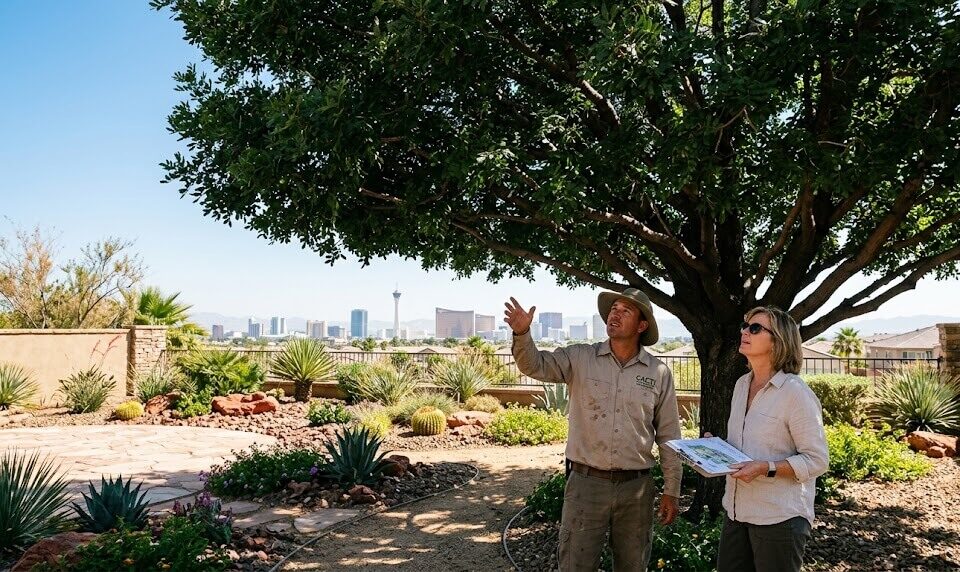
When choosing a shade tree for a desert yard, understanding root behavior and where to plant it is more important than picking the most popular species. Expert tree selection and planting services can help ensure your shade tree thrives for years to come.
Root System First
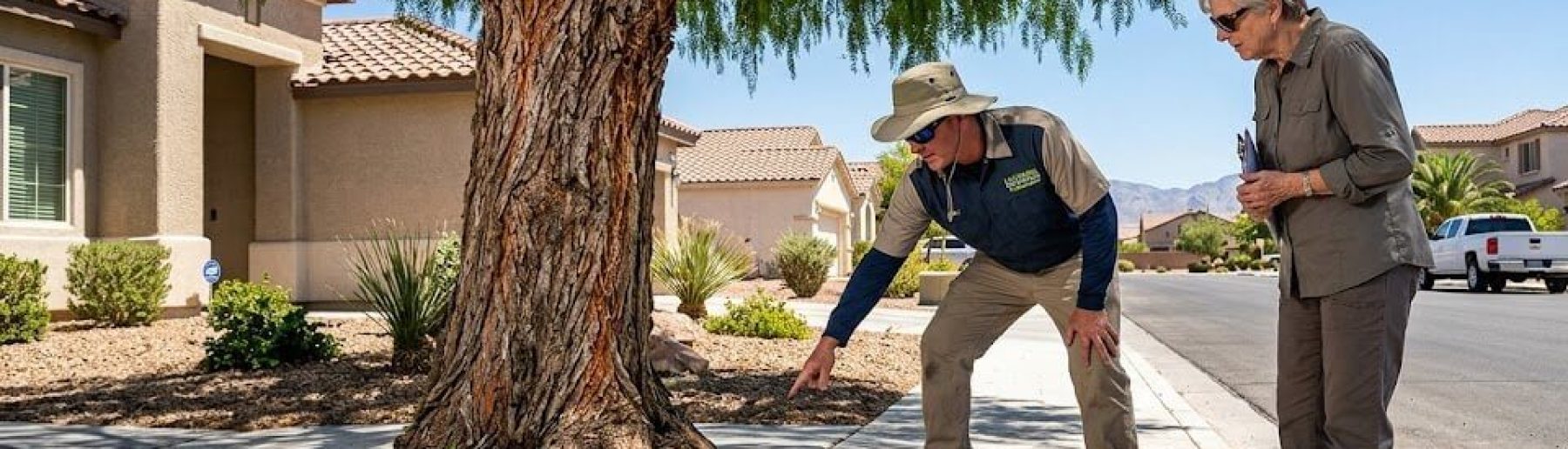
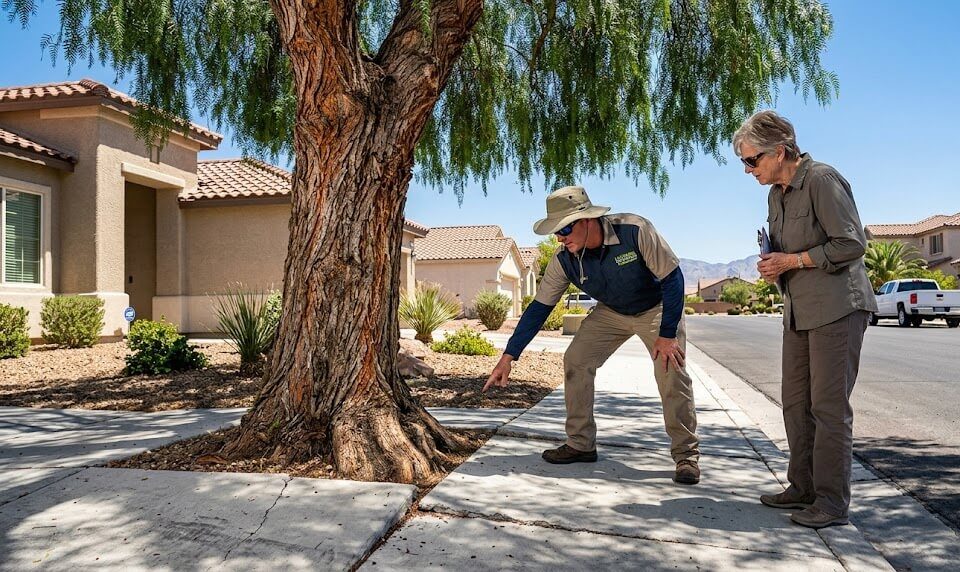
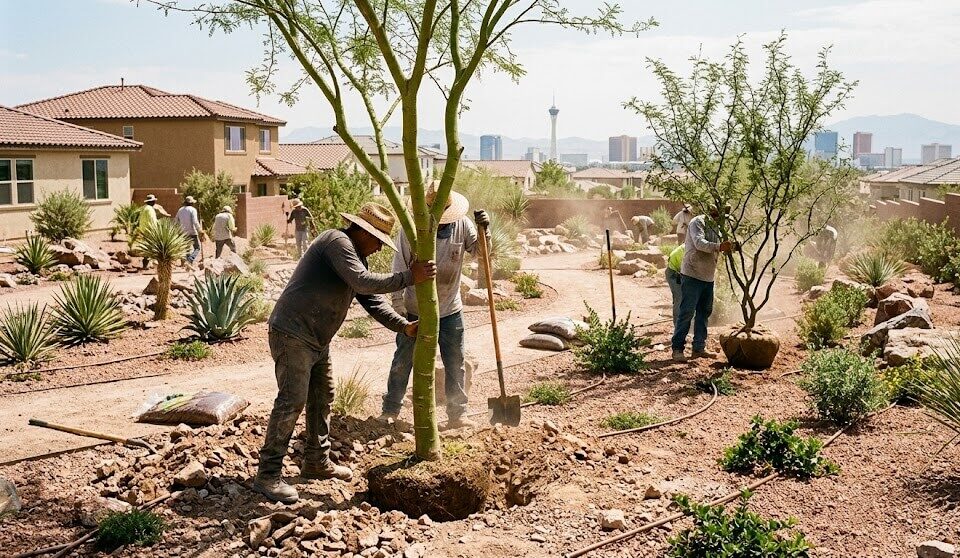
African Sumac and California Pepper Tree both expand aggressively underground. Placing either within 10 feet of pool equipment, irrigation mainlines, or concrete flatwork creates expensive repair problems within 5–8 years.
Match Canopy Density to Wall Exposure
West-facing walls absorb the most sustained heat in Las Vegas; they need broad, dense canopies placed to intercept afternoon sun. North and east exposures can handle lighter options like Palo Verde.
Check Water Classifications Before Purchasing
SNWA’s Water Smart plant list provides water-use ratings aligned with Valley conservation standards. For best shade trees for front yard placement near sidewalks, Palo Verde and Fruitless Olive are safer root-wise than African Sumac or California Pepper Tree. For best small trees for shade in compact spaces, both appear on the recommended list.
Soil Prep for Non-Native Species
Las Vegas soil is alkaline and compacted. Desert natives handle it without amendment; ornamentals don’t.
Beyond proper drip line placement and root zone preparation, consider creative ideas for landscaping around trees, like shrubs, rocks, or ground cover, to enhance shade, beauty, and overall curb appeal.
For site-specific questions about root clearance and irrigation setup before you purchase, contact Cacti Landscapes directly.
Common Mistakes When Planting Shade Trees in Las Vegas
- Planting too close to structures. Account for mature canopy radius, not nursery container size. A tree that clears a wall comfortably today can be a structural and root problem within a decade.
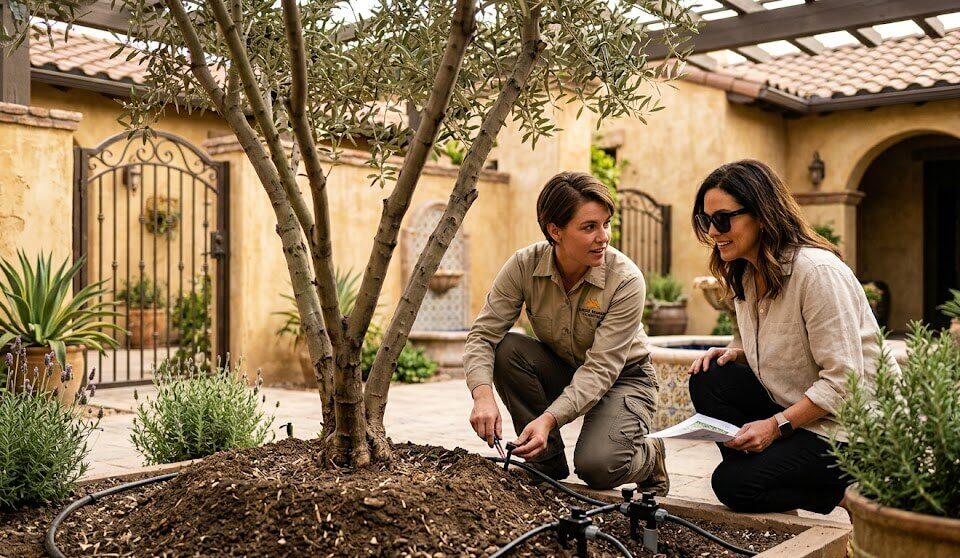
- Overwatering during establishment. In Las Vegas alkaline soil, overwatering triggers root rot faster than drought stress does in the first growing season. Desert-adapted trees need consistent early irrigation, which is less than most homeowners assume.
- Ignoring root behavior. This is the most expensive mistake on the list. African Sumac and California Pepper Tree are the most common offenders; underground repairs near damaged irrigation or concrete can run into thousands of dollars depending on what gets hit.
- Planting in peak summer. Late fall through early spring planting allows root systems to establish before the first hard summer. That timing decision improves 5-year survival more than species selection does.
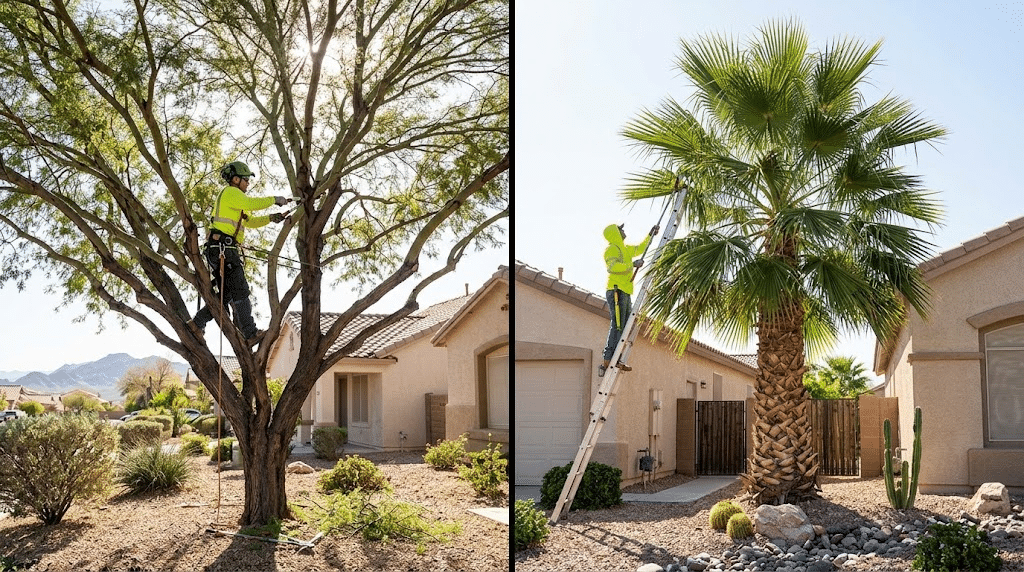
The local tree and landscaping services in Las Vegas include post-planting care programs designed for desert tree species.
Final Thoughts
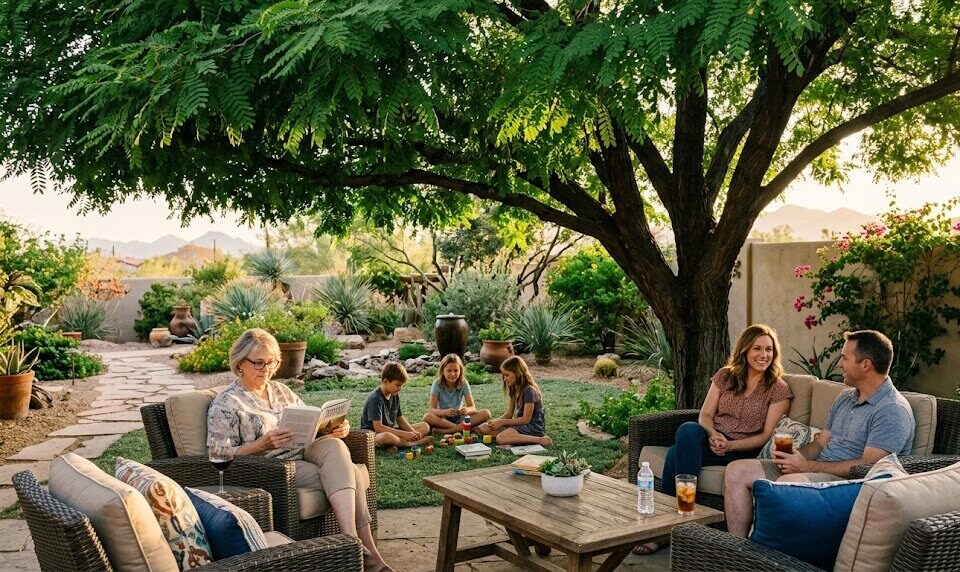
The best shade trees for a Las Vegas yard are the ones matched to the actual site: soil condition, root clearance, irrigation capacity, and sun exposure all determine success more than the species catalog does. Desert natives like Mesquite and Palo Verde ask little and deliver consistently. Fast growers like African Sumac and Tipu Tree reward planning with quick canopy. Get that match right, and a tree planted this season will perform for the next 20 years.
FAQ
The questions below address the most common searches around shade tree selection in Las Vegas.
What is the best shade tree for Las Vegas?
African Sumac is the most widely recommended option: it’s fast, drought-tolerant once established, and delivers dense year-round canopy. For minimal-irrigation yards, Mesquite and Palo Verde are both strong alternatives native to the Mojave.
What is the best shade tree for a backyard?
It depends on yard size. Tipu Tree and African Sumac grow fast and spread wide, strong choices for large backyards where quick coverage is the priority. Smaller spaces are better served by Fruitless Olive or Holly Oak, both of which deliver dense shade without the root risk near underground infrastructure.
What trees grow best in Nevada?
Desert-adapted species perform best: Mesquite, Palo Verde, African Sumac, and Desert Willow all evolved for alkaline soil, low rainfall, and sustained heat. Non-native ornamentals can be established with soil prep and managed irrigation, but they need more consistent input to stay healthy through a Las Vegas summer.
What is the most common tree in Las Vegas?
African Sumac and non-native Ash trees have historically dominated Las Vegas residential landscapes. Ash has fallen out of favor due to higher water demands and pest susceptibility. Desert-adapted species are now the standard recommendation across the Valley.
What are the fastest-growing shade trees?
African Sumac, Tipu Tree, and California Pepper Tree are the fastest-growing options for Las Vegas conditions, all capable of significant canopy within 3–5 years. Mesquite grows at a moderate-to-fast rate while requiring far less water, making it the stronger pick when both speed and drought tolerance matter.