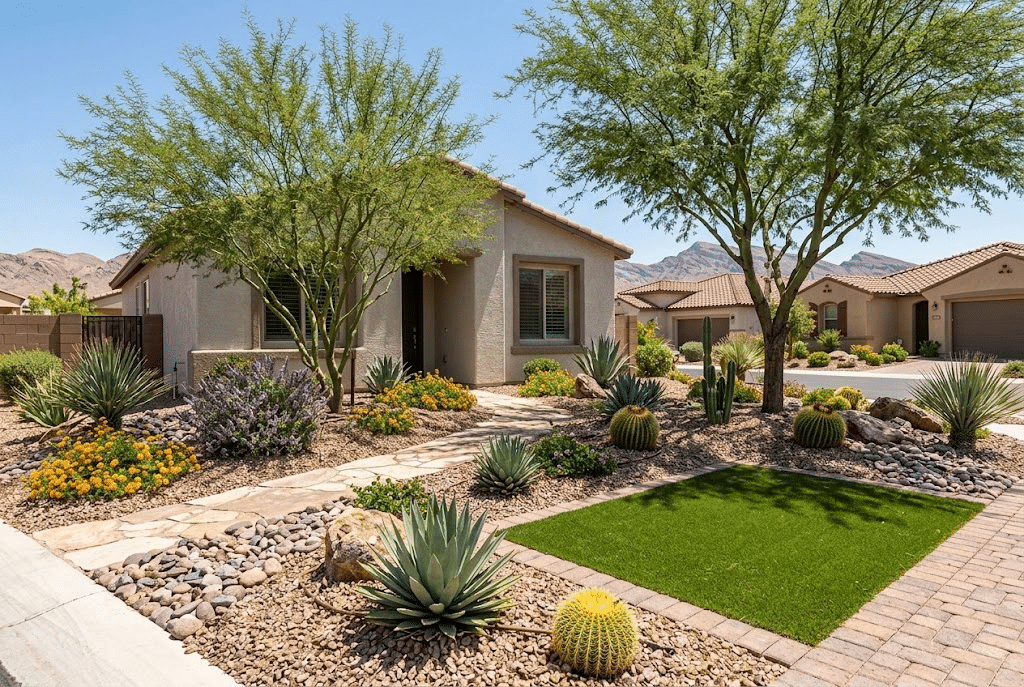
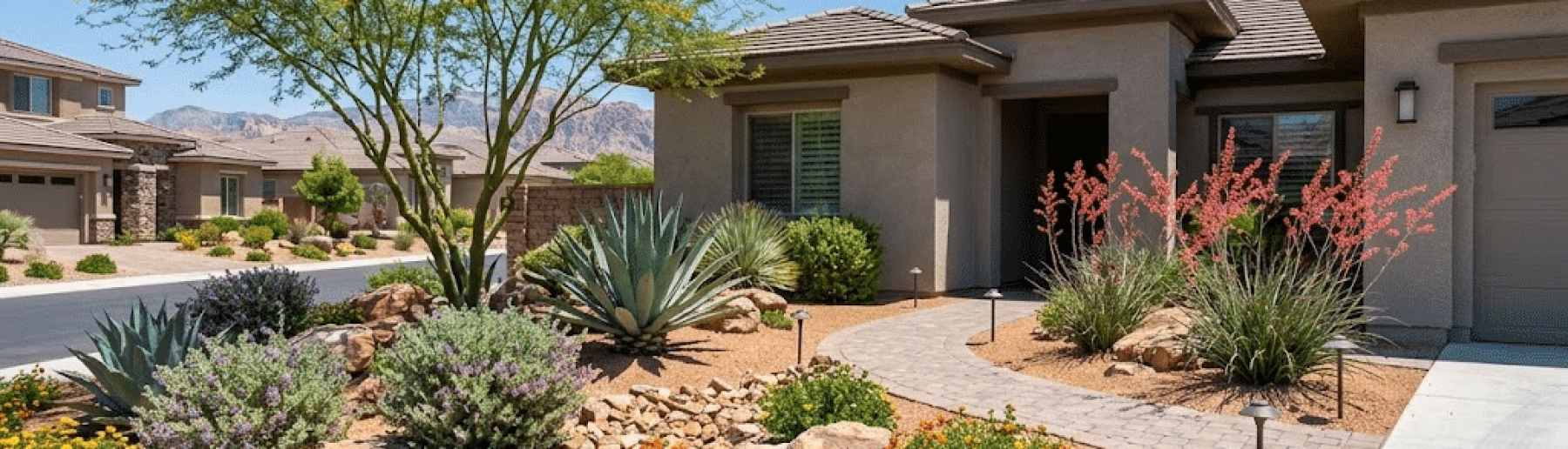
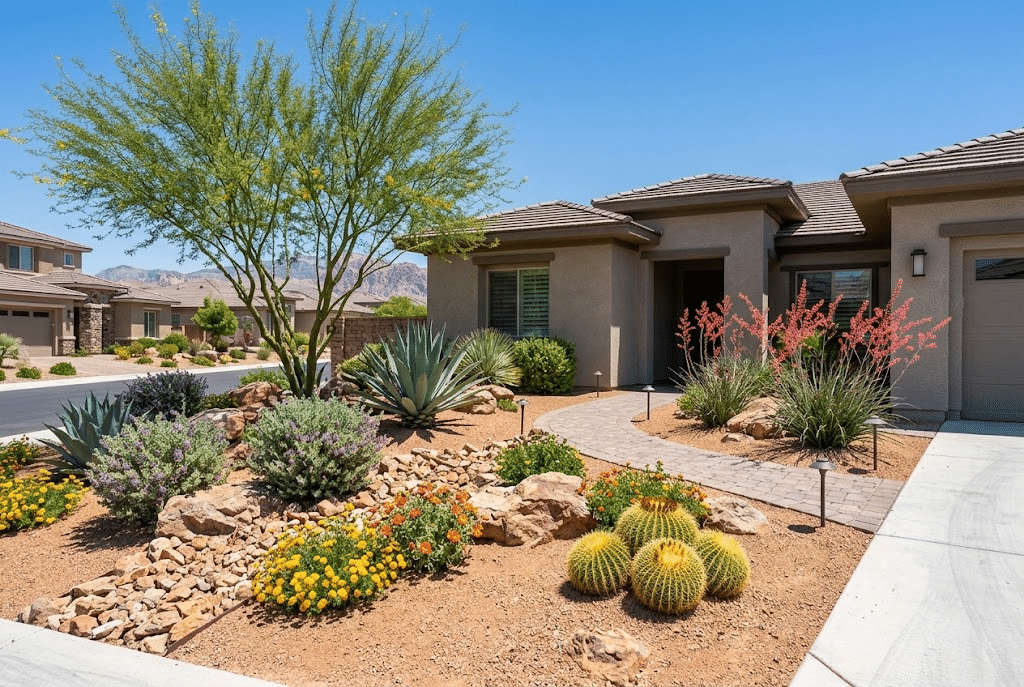
Summerlin HOA landscaping rules require Design Review Committee approval before any landscaping work begins. Under Summerlin West’s 2026 guidelines, front yards need at least 40% live plants or organic groundcover, no more than 60% hardscape, earth-tone rock in no more than two colors, and low, thornless plants near sidewalks. Desert landscaping, artificial turf, and new trees are all allowed with approval.
Summerlin has three master associations: North, South, and West. Each publishes its own Design Guidelines and Standards, and many neighborhoods add a sub-association with stricter rules. This guide uses the Summerlin West guidelines updated January 1, 2026, and notes key differences in Summerlin North, which counts artificial turf as hardscape. Confirm the current version for your village at summerlink.com before you plan.
If you’d rather not handle the design review process yourself, our Summerlin landscaping services cover everything from a plan that meets your village’s guidelines to the final install.
Who Sets the Landscaping Rules in Summerlin
Every exterior change in Summerlin goes through a Design Review Committee, including front-yard and backyard landscaping. That covers new plants, rock, turf, walkways, lighting, and irrigation changes, not just major construction.
Skipping approval is expensive. Under the Summerlin West guidelines, unapproved work can lead to a hearing, a fine, a stop work order, and removal of the work at your cost. City permits do not replace HOA approval, and HOA approval does not replace city permits.
Where a sub-association’s rules are stricter than the master association’s, plan around the stricter rule.
What Summerlin HOAs Typically Allow vs. Restrict
Quick reference from the Summerlin West 2026 guidelines:
| Usually allowed (with approval) | Usually restricted or prohibited |
| Desert and drought-tolerant landscaping | White rock, painted rock, and white edging |
| Earth-tone rock, up to two colors in the front yard | Bare dirt in any planter or groundcover area |
| Artificial turf that meets product and install specs | Mixing natural grass and artificial turf in a front yard |
| Boulders and larger rock in accent areas | Artificial plants and trees in front and side yards |
| Subtle, low-level landscape lighting | Wood materials like railroad ties and bark over 5% of the front yard |
| Tree replacement with approved species | Common Bermuda grass, mulberry, fruiting olive, and cottonwood |
Rock vs. Turf vs. Plants: Summerlin Front-Yard Ratios
Under the Summerlin West rules, horizontal hardscape cannot exceed 60% of the front and side yard, and at least 40% must be live plants or organic groundcover at ground level. Rock mulch counts as hardscape, so it falls inside that 60% limit along with walkways, steps, and planter walls.
Ratios like this sit at the heart of HOA-approved landscaping in Las Vegas, and in Summerlin, that 40% is the number to watch. Artificial turf counts as non-organic softscape, so it does not help you hit the live plant minimum. A front yard that is half turf and half rock will not pass, even though it looks green from the street. In Summerlin North, turf is classified as hardscape, so it also counts toward the 60% cap.
A quick way to check your plan: in a 1,000 square foot front yard, at least 400 square feet must be planted. Rock, paths, and turf share the remaining 600.
Rock rules are just as specific:
- Rock must be at least 2 inches deep, with no exposed soil.
- Front-yard rock should be 3/8 inch to 3/4 inch in size, with larger rock and boulders allowed as accents.
- No more than two rock colors, and they need to be closely related.
- Colors must be natural earth tones that complement the house.
- Most of the front yard should match the established rock color and size for your neighborhood.
Pea gravel, rock fines, and minus materials are reviewed case by case because they wash out on slopes. If your existing rock has thinned or faded, rerocking in your neighborhood’s established color is often the simplest approved upgrade.
Artificial Turf Rules in Summerlin
Artificial turf is allowed in Summerlin West front yards, but it comes with more conditions than any other material. Your application needs the product spec sheet and the installation method. The turf also has to meet minimum standards for fiber type, face weight, pile height, and infill.
A few installation rules catch homeowners by surprise:
- Turf must sit at least 3 feet from the house and all property line walls.
- Every edge needs a hard border, such as pavers, flagstone, boulders, or a mow curb.
- Where turf meets a neighbor’s grass or turf, a separation of at least 12 inches is required.
- Only one type of artificial turf can be used in the front yard.
- Turf is not allowed inside front-yard raised planters.
- Trees inside turf areas need a mulched ring at least 12 inches beyond the trunk at maturity.
- The finished turf must show no visible nails, wrinkles, or open seams.
Plant Height Near Sidewalks and Parkways
Summerlin wants streets to look continuous and sidewalks to stay clear. Under the Summerlin West rules, any hedge-type planting in a parkway strip, or within 12 inches of a public sidewalk, cannot grow taller than 36 inches and cannot have thorns.
Parkway strips, the planted area between the sidewalk and the curb in some neighborhoods, have their own rules. You can redesign them as part of your front yard, but you must keep the same number of trees the builder planted. You also need at least 40% softscape, and every plant must stay at 36 inches or less at maturity and have no thorns. These parkway rules come from Summerlin West; in Summerlin North, parkway strips only need to match the design of the rest of the front yard.
This rules out several desert favorites in parkway strips, and they are best kept away from sidewalks in general. Agave, desert spoon, and most cactus have spines, so keep them farther back in the yard. Good low, thornless choices for sidewalk edges include:
- Blackfoot daisy
- Damianita
- Trailing lantana
- Dwarf ruellia
- Compact autumn sage, kept pruned below 36 inches
Front-Yard Uniformity Rules in Summerlin
Summerlin’s guidelines are built around a consistent look from house to house, so several rules exist mainly to keep streets visually connected.
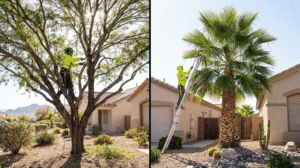
Trees. Most Summerlin West front yards need two 24-inch box trees, with at least a 1.5-inch trunk caliper or 6 feet of height. Corner lots normally need two more on the street side. Lots with 55 feet of frontage or less, or odd-shaped lots, need at least one. Builder-installed trees can be removed or replaced, but only with approval. If you are replacing one, include the new tree planting in your submission.
Walls and planters. Front-yard retaining walls, raised planters, and decorative walls max out at 36 inches tall. They must be set back 4 feet from the curb or 2 feet from the sidewalk. Unfinished concrete blocks are not accepted.
Ornaments and features. Front-yard ornaments are typically limited to three, each no taller than 3 feet. Statues and water features in front of the building setback also top out at 3 feet unless they sit inside a courtyard, where they can reach 6 feet. Summerlin North allows only one statue or water feature.
Walkways. New walkways from the curb or sidewalk need at least 18 inches of planting between the path and the property line, and 12 inches between the path and the driveway.
Summerlin Landscaping Ideas That Fit the Rules
The rules are tight, but they still leave plenty of room for a yard that stands out. These ideas tend to move through review smoothly because they meet the 40% plant minimum without fighting the neighborhood look.
Layered Desert Planting
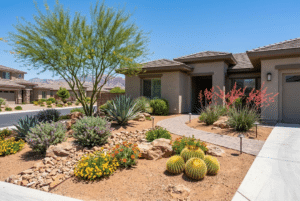
Use the neighborhood rock as your base, then build depth with three layers: a shade tree, mid-height flowering shrubs, and low groundcover along the walk. Texas ranger, Mexican bird of paradise, and autumn sage fill the middle layer well. Desert willow and Desert Museum palo verde are common shade tree choices; check them against your village’s recommended plant list.
A Turf Panel With a Clean Border
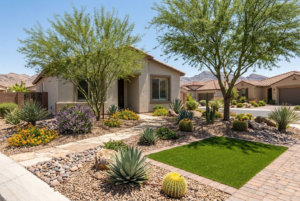
If you want green, keep turf to one defined panel framed by pavers or flagstone. Then fill the rest of the yard with xeriscape plants densely enough to clear the 40% live plant rule.
Boulder and Accent Clusters
Group two or three boulders with an accent plant like red yucca set back from the sidewalk. Larger rock is allowed in accent areas, so this adds texture without breaking the rock size rule.
Low-Level Lighting
Summerlin encourages subtle lighting on facades and front-yard plants, and lighting at least one address plaque is required. Build your plan around the plaque, then add uplighting on a single tree. Keep pole-mounted fixtures at 6 feet or lower and wall-mounted fixtures at 10 feet or lower.
A strong xeriscape plan does most of the work here. It keeps water use low, hits the coverage rules, and gives the committee a clear plant list to approve.
Irrigation Rules in Summerlin Yards
Irrigation is part of your HOA submission, not an afterthought. Your landscape plan needs to show where irrigation lines and emitters will go.
Summerlin West also protects shared walls from water damage:
- Natural grass and artificial turf must stay at least 3 feet from perimeter and property line walls.
- Only drip irrigation is allowed inside that 3-foot zone.
- Spray heads must stay 3 feet from walls and point away from them.
Many older Summerlin yards still have spray heads close to block walls, or zones that were never fully converted to drip after grass was removed. Fixing that before you replant protects your walls and keeps you compliant. We start every irrigation job with an $80 flat-rate irrigation evaluation, so you get a clear list of what needs repair or conversion at a set price before you submit your plan. See our irrigation repair and conversion services for details.
How to Get Your Summerlin Landscape Plan Approved
The approval process is straightforward if your submission is complete the first time:
- Download the current Design Guidelines and Standards for your master association, and check whether your sub-association has its own rules.
- Draw a landscape plan showing every plant, all landscape, and the irrigation layout.
- Include product specs for artificial turf, rock samples or specs, and wall materials if they apply.
- Submit the Improvement Request Form with your plan.
- Wait for written approval before any work begins.
Under the Summerlin West guidelines, the committee has up to 30 days to decide on a complete application, and a typical review takes 10 to 15 working days. Incomplete applications may not be processed at all, or may be treated as unapproved, which means submitting a new, complete application. If the committee asks for more information, allow up to 30 more days after you send it. Once approved, the work needs to be finished within 180 days of the start date you list. If you leave the start date blank, the approval date counts as the start.
If you want a plan built around your village’s guidelines from the start, our design team can help you put together a layout and plant list ready for review.
Frequently Asked Questions
What are the Summerlin HOA landscaping rules?
Summerlin HOAs require Design Review Committee approval before any landscaping work. In Summerlin West, front yards need at least 40% live plant coverage, no more than 60% hardscape, and up to two earth-tone rock colors.
Is artificial turf allowed in Summerlin front yards?
Yes, with approval. The turf must meet product specifications, sit at least 3 feet from walls and the house, and have a hard edge. It cannot be mixed with natural grass in the front yard.
Can I use white rock in Summerlin?
No. Summerlin West and Summerlin North both prohibit white rock, painted rock, and white edging in front yards. Summerlin West extends the ban to anywhere visible from streets or common areas, and Summerlin North also bans light-colored rock.
How tall can plants be near the sidewalk in Summerlin?
Hedge-type plants in parkway strips or within 12 inches of a public sidewalk cannot exceed 36 inches in height and cannot have thorns.
How long does Summerlin HOA landscape approval take?
The committee has up to 30 days to decide on a complete application. A typical review takes 10 to 15 working days.
What plants are prohibited in Summerlin?
Summerlin West and Summerlin North both prohibit common Bermuda grass, common mulberry, and cottonwood, along with artificial plants in front and side yards. Summerlin West bans fruit-bearing olive trees, while Summerlin North bans common olive trees in general.
Work With a Summerlin Landscaping Contractor Who Knows the Guidelines
Cacti Landscape has worked in Las Vegas Valley yards since 2002, including Summerlin neighborhoods with strict design review. We plan around your HOA’s rules from the start, so your project is built to pass review and stay compliant.