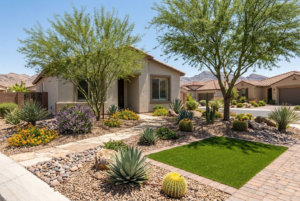
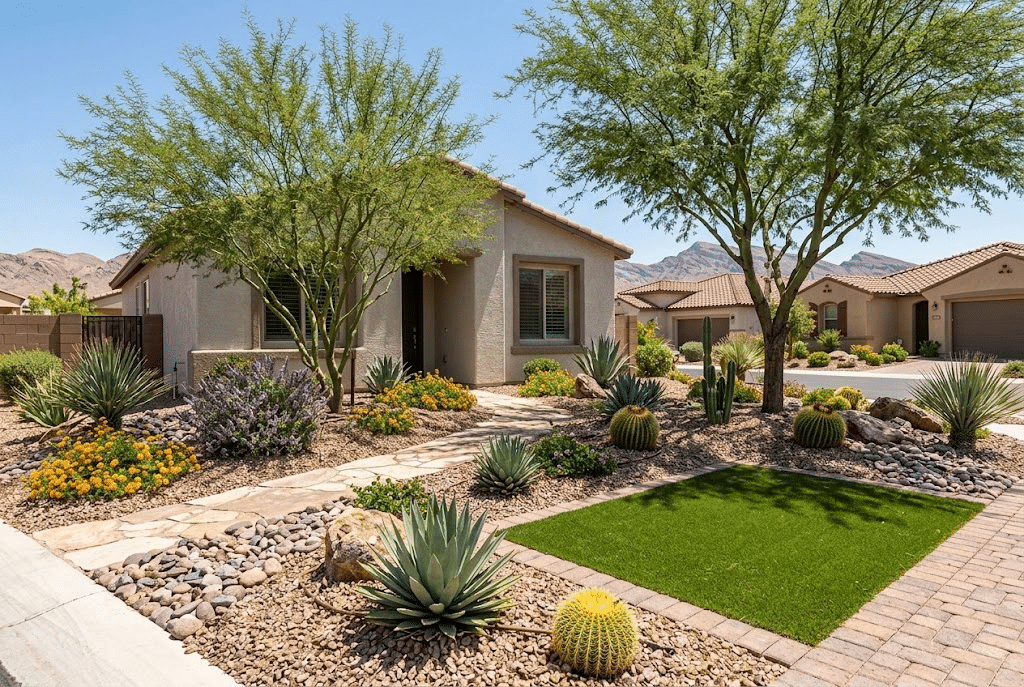
Landscaping in Spring Valley, NV comes down to four things: breaking through caliche soil, following your LVVWD watering group, choosing plants that thrive on drip irrigation in 110°F heat, and staying within your HOA’s guidelines. Get those right, and your yard can stay healthy year-round on a fraction of the water a traditional lawn needs.
Spring Valley sits just west of the Strip, covering ZIP codes 89103, 89117, 89146, 89147, and 89148, including neighborhoods like The Lakes and Rhodes Ranch. Most homes here were built between the 1980s and early 2000s, so many still have original sprinkler systems, aging drip lines, and lawns installed when water rules were far looser. That history shapes almost every project we take on.
Below, we cover what Spring Valley homeowners face most often, from soil preparation to watering rules and project costs. If you’d rather hand the work off, professional Spring Valley landscaping services can handle everything from irrigation repairs to full turf conversions.
Caliche Soil in Spring Valley: Why It Changes Every Project
Caliche is a dense layer of soil cemented together by calcium carbonate. Across Spring Valley, it might turn up just a few inches below the surface or sit several feet down. Depending on your lot, it can range anywhere from a thin crust to a solid rock-like slab that stops a shovel in its tracks.
Caliche is a problem because neither water nor plant roots can easily penetrate it. For instance, if you plant a tree in a hole dug directly above caliche, you’ve created an underground bathtub. As water pools at the bottom, roots remain shallow or start circling the hole. Over time, the tree either slowly weakens or gets knocked over by strong spring windstorms.
Because of this, before you plant anything larger than a 5-gallon shrub, it’s wise to run a quick drainage test:
- Dig the planting hole and fill it with water.
- Let it drain, then fill it again.
- If water from the second fill is still standing after about 24 hours, you have a drainage problem.
The fix is to break through the caliche layer with a heavy digging bar, auger, or jackhammer so water can drain freely. For trees, drilling a narrow drainage chimney through the bottom of the hole is usually enough. Keep your backfill mostly native soil. A heavily amended mix creates a soft pocket that roots may never grow out of.
Spring Valley soil is also highly alkaline, which locks up iron and turns the leaves of sensitive plants yellow with dark green veins. That condition is called iron chlorosis. Choosing desert-adapted plants for xeriscaping that tolerate alkaline soil from the start saves you years of treating it with supplements. That’s why a good desert landscape begins with plant selection, not with laying down rock.
LVVWD Watering Schedule for Spring Valley
Since Spring Valley homes fall under the Las Vegas Valley Water District, LVVWD’s mandatory schedule applies to your property. Your specific watering group (assigned from A through F) is listed on your monthly water bill and can be double-checked anytime at lvvwd.com. Keep in mind that watering outside your assigned days counts as water waste and can lead to hefty fines.
| Season | Months | Days allowed |
| Spring | March to April | 3 days per week |
| Summer | May to August | Up to 6 days per week, no sprinkler watering 11 a.m. to 7 p.m. |
| Fall | September to October | 3 days per week |
| Winter | November to February | 1 day per week |
However, a few lesser-known rules frequently catch homeowners off guard:
- Sprinkler watering is never allowed on Sundays.
- The day limits apply to drip systems too, not just sprinklers.
- In fall, groups A, C, and E water Monday, Wednesday, and Friday, while groups B, D, and F water Tuesday, Thursday, and Saturday.
- New or reseeded landscapes can be watered daily for up to 14 days, once per calendar year, if you notify LVVWD first.
- Hand watering with a hose and supervised system testing are allowed any time.
The next change comes November 1, when the mandatory winter schedule cuts every watering group to one day per week. According to LVVWD, fall is when overwatering happens most, because many homeowners forget to reset their controllers when the season changes.
For drip-irrigated plants, LVVWD recommends watering about two days a week in spring and fall, then once a week or less in winter. Sprinkler zones should run about 12 minutes per watering day, split into three 4-minute cycles about an hour apart. This lets the water soak into the soil instead of running off into the gutter.
If seasonal controller changes tend to slip your mind, a landscape maintenance plan takes them off your plate.
Xeriscape in Spring Valley: Turf Rules, Rebates, and Plant Picks
Most Spring Valley yard transformations begin with removing nonfunctional grass. In fact, under Nevada law (AB 356), using Colorado River water to irrigate nonfunctional turf will be banned starting January 1, 2027. While this rule primarily targets HOA common areas, medians, and commercial spaces rather than private backyards, it is nevertheless reshaping the look of neighborhoods across Spring Valley.
If you’re planning to remove your lawn, check the Southern Nevada Water Authority’s Water Smart Landscapes rebate at snwa.com before tearing anything out. For single-family homes, the program currently pays $5 per square foot for the first 10,000 square feet of grass converted to water-smart desert landscaping. Your application must be approved by SNWA before any work begins.
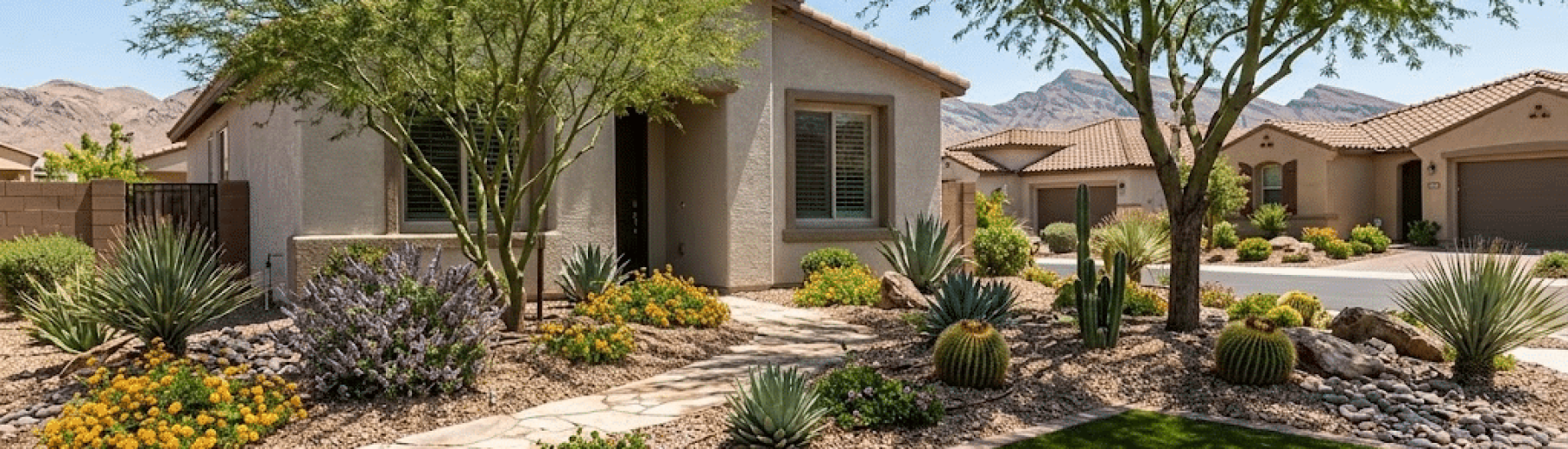
A well-planned xeriscape design for Spring Valley involves much more than gravel and a few cacti. It relies on layered plants, strategic shade, and drip lines matched to each plant’s water needs.
Plants That Handle Spring Valley Conditions
Once established, these plants handle intense heat, desert winds, alkaline soil, and the LVVWD watering schedule well:
- Shade trees: Desert Museum palo verde, desert willow, thornless mesquite
- Flowering shrubs: Texas ranger, Mexican bird of paradise, autumn sage
- Accents: red yucca, desert spoon, agave
- Groundcover: trailing lantana, blackfoot daisy, damianita
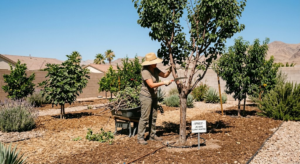
Ideally, position shade trees on the west and south sides of your home where intense afternoon sun hits hardest. Additionally, be sure to keep them placed at least 8 to 10 feet away from walls, pools, and foundation structures so both the root system and canopy have plenty of room to grow.
HOA Rules in Spring Valley Communities
Many Spring Valley communities, especially master-planned developments like The Lakes and Rhodes Ranch, enforce strict architectural review standards. Unapproved changes to your front yard can quickly lead to violation notices or even orders to undo completed work.
Therefore, before starting any work, request a copy of your HOA’s specific landscaping guidelines and carefully review:
- Approved and prohibited plant lists
- Required rock color, size, and depth
- Minimum plant coverage percentages for front yards
- Rules on trees, boulders, and decorative features
- Submission requirements and review timelines
A typical submission includes a basic site layout, a plant schedule with sizes, rock samples or specs, and an irrigation plan. Review can take several weeks, so build that time into your project schedule, especially if you want to finish before summer heat arrives or need to meet a rebate deadline. Working with a local landscaping company in Spring Valley that routinely works with HOA boards can save you from tedious revisions.
Irrigation in Spring Valley: Fix the System Before the Plants
In older Spring Valley homes, the existing irrigation setup is frequently the most vulnerable part of the landscape. The most common issues we run into include:
- Drip tubing that has gone brittle from years of UV exposure
- Emitters clogged with calcium from hard Las Vegas water
- Leaking valves and sprinkler heads left uncapped after grass removal
- Controllers that cannot be programmed for the seasonal schedule
- Grass zones that were never properly converted to drip
New plants struggle on a failing system, which is why fixing irrigation issues is step number one. For that reason, we start every project with an $80 flat-rate irrigation evaluation. A licensed technician thoroughly tests your controller, valves, and lines to provide a clear diagnosis of needed repairs or conversions before you invest in new plants.
In addition, upgrading to a smart irrigation controller is a great investment. These weather-smart systems automatically tweak watering runtimes based on real-time conditions, making seasonal adjustments practically effortless.
Landscaping Costs in Spring Valley
While overall landscaping costs in Spring Valley vary widely depending on the scope of work, several key factors consistently drive project estimates:
- Irrigation: Repairing an existing irrigation system costs less than a full replacement or sprinkler-to-drip conversion.
- Square footage: Turf removal and rock conversion are usually priced by area.
- Caliche: Heavy caliche adds excavation time for every tree and large shrub.
- Demolition and haul-off: Removing old grass, dead plants, and debris adds labor and dump fees.
- Rock and materials: Rock type, size, and depth affect both material and delivery costs.
- Plant sizes: A 24-inch box tree costs far more than a 15-gallon, but gives you shade a few years sooner.
- Access: Narrow side yards and backyard-only access slow down material delivery.
Ask contractors to break down their estimates line by line using these factors. If your grass conversion qualifies, also factor in savings from the Water Smart Landscapes rebate.
Frequently Asked Questions
What is the best landscaping for Spring Valley, NV?
Overall, desert xeriscaping paired with drip irrigation is the most reliable setup for Spring Valley. Combining drought-tolerant shade trees with colorful flowering shrubs, rock groundcover, and an efficient drip system tailored to the LVVWD schedule keeps your yard looking great. Check out our Spring Valley landscaping services for more details on how we tailor projects to your local area.
What watering group am I in?
Your watering group is printed on your LVVWD water bill. You can also look it up at lvvwd.com using your address.
Can I water my yard on Sunday in Spring Valley?
No. Sprinkler watering is prohibited on Sundays year-round. Hand watering with a hose is allowed any day.
Do I need HOA approval to change my front yard?
In most Spring Valley planned communities, yes. Submit your plan to the architectural review committee and wait for written approval before starting work.
How do I deal with caliche when planting a tree?
Break through the caliche layer at the bottom of the planting hole so water can drain. Test drainage first by filling the hole twice with water.
How much does an irrigation evaluation cost?
Cacti Landscape offers a flat-rate irrigation evaluation for $80. A licensed technician inspects your controller, valves, and lines and explains what needs repair.
Talk to a Spring Valley Landscaping Company That Knows the Ground
At Cacti Landscape, we’ve been working in Las Vegas Valley yards since 2002, so we know firsthand what Spring Valley’s unique soil, strict water rules, and local HOAs require. Whether you’re planning a complete turf conversion, need irrigation repairs, or want ongoing maintenance, our team is ready to help you get it done right.
Give us a call today at (702) 370-5000 to set up your $80 flat-rate irrigation evaluation or chat through your project ideas. Licensed Nevada Contractor #84942.