
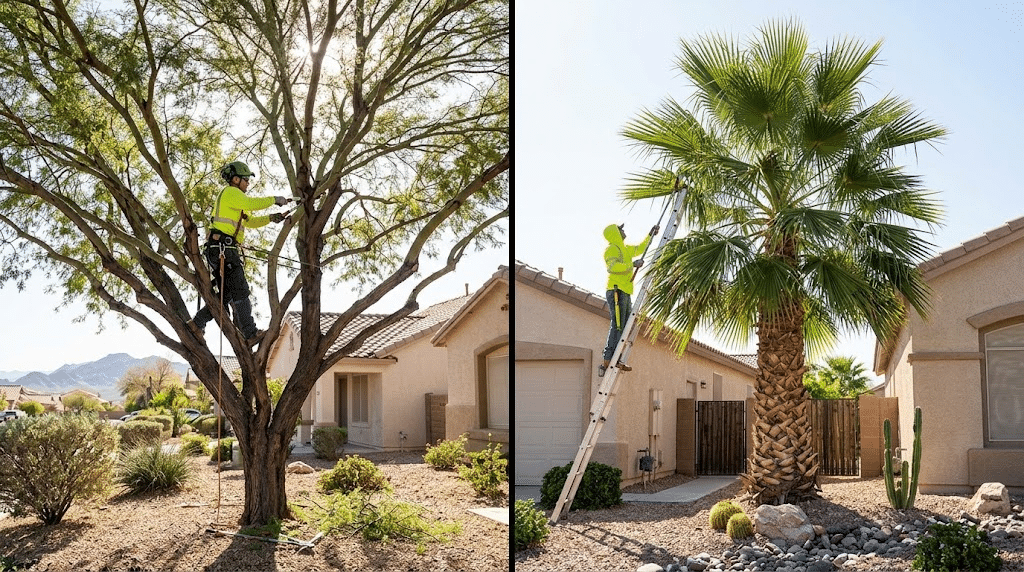
Tree pruning vs. trimming comes down to purpose. Pruning removes specific branches to fix a tree’s health, structure, or safety. Trimming cuts back overgrowth to control size, shape, and clearance around your home. Most trees in Las Vegas and Henderson need both over their lifetime, but for different reasons and at different times of year.
The difference matters more in the Las Vegas Valley than in most of the country. Monsoon winds, 110-degree summers, and shallow roots in caliche soil punish trees that were cut the wrong way. A mesquite that was only sheared for looks can split in a July storm. A palm that was over-trimmed loses the green fronds it needs to feed itself.
What follows covers what each service actually involves, how to tell which one your tree needs, and which cuts to refuse no matter what a crew calls them.
Tree Pruning vs. Trimming: The Quick Comparison
| Pruning | Trimming | |
| Main goal | Health, structure, and safety | Size, shape, and clearance |
| What gets cut | Selected dead, diseased, crossing, or weakly attached branches | Overgrown outer growth, low limbs, branches near roofs, walls, and walkways |
| How cuts are made | One branch at a time, just outside the branch collar | Shortening or shaping growth across the canopy |
| Skill needed | Knowledge of tree biology and structure | Good technique and safe equipment |
| Typical frequency in Las Vegas | Every 1 to 3 years, yearly for fast growers like mesquite | As growth requires, often yearly for palms |
| Risk if done wrong | Decay, weak regrowth, branch failure | Sunscald, dense weak sprouts, lopsided canopy |
| Best for | Pre-monsoon thinning, young trees, storm damage, diseased limbs | Palm fronds and seed pods, HOA clearance, sight lines |
The simplest way to remember it: trimming changes how a tree looks this year. Pruning changes how it grows for the next 10.
What Is Tree Pruning?
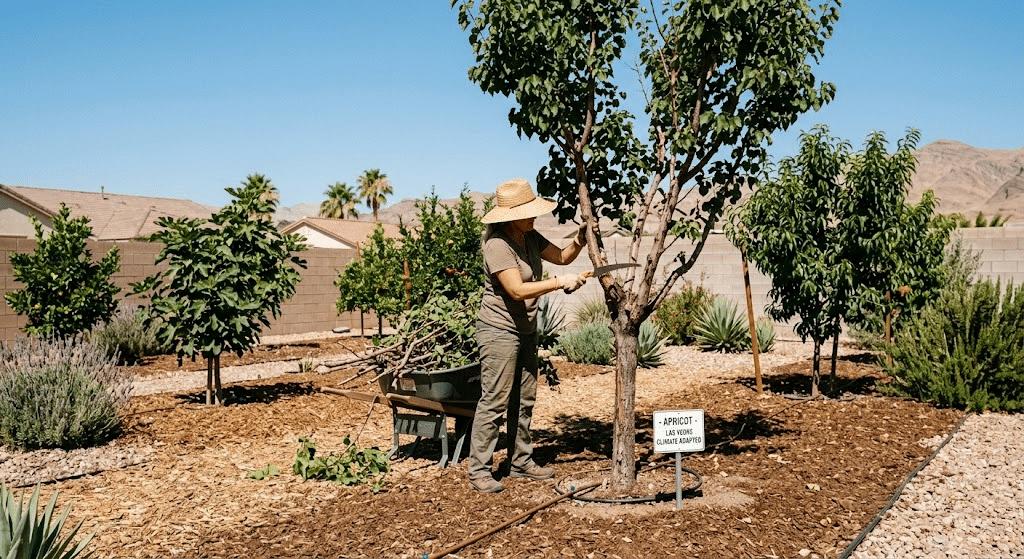
Tree pruning is the selective removal of branches to improve a tree’s health, structure, or safety. Every cut has a reason behind it: a dead limb, two branches rubbing, a weak V-shaped attachment, or a limb growing toward the house that will become a problem in a few years.
Professional tree care in the U.S. follows the ANSI A300 pruning standard, which organizes the work by objective:
- Cleaning: removing dead, diseased, broken, and weakly attached branches
- Thinning: removing select live branches to reduce weight and let wind pass through the canopy
- Raising: removing lower limbs to clear driveways, walkways, and roofs
- Reduction: shortening a tree’s height or spread by cutting back to a side branch, never to a stub
- Structural pruning: shaping young trees so they develop a strong central structure and well-spaced branches
Here’s what most homeowners don’t realize. Industry standards describe all of this work as pruning. “Trimming” is the everyday word homeowners and many crews use for the lighter end of it. So when you compare proposals, the label on the invoice matters less than the objective behind each cut. A vague plan like “we’ll clean it up” usually means the crew intends to shear the outside of the canopy for looks.
What Is Tree Trimming?
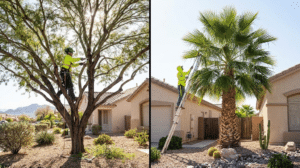
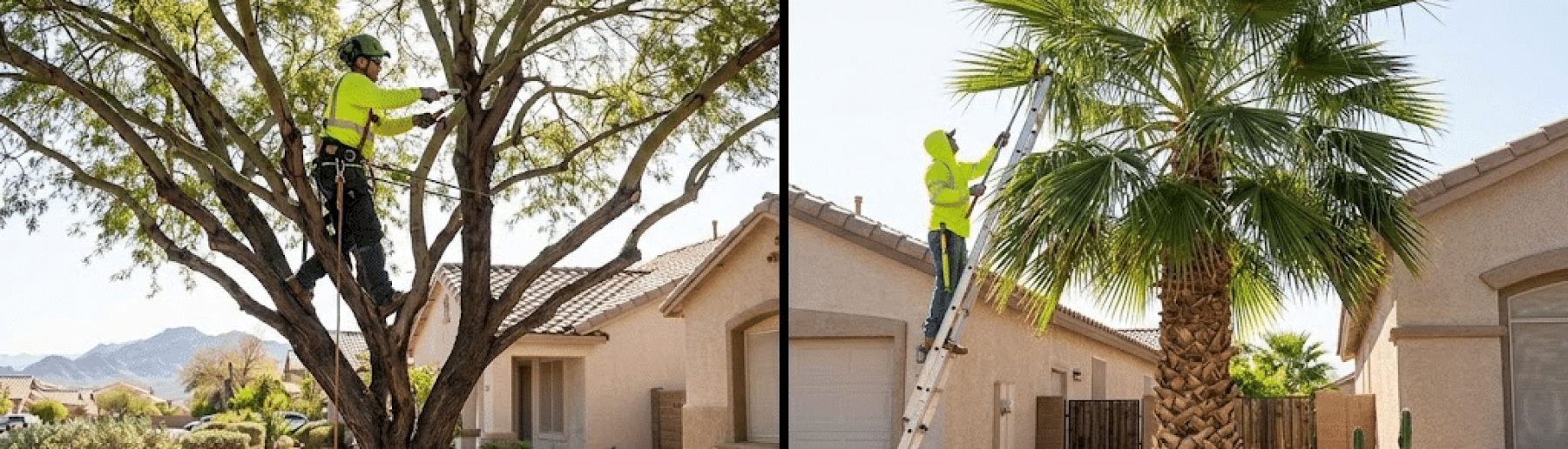
Tree trimming is cutting back growth to control a tree’s size, shape, and clearance. It’s the work that keeps branches off your roof and block wall, out of the pool, clear of the sidewalk, and within HOA rules.
The most common trimming jobs in Las Vegas and Henderson yards include:
- Removing dead fronds and seed pods from fan and date palms
- Cutting back limbs that scrape the roof, stucco, or solar panels
- Lifting low branches over driveways and walkways
- Keeping sight lines clear at driveways and corners
- Shaping trees and large shrubs to fit the rest of the landscape
Trimming is lighter, faster, and less technical than pruning, which is also why tree trimming in Las Vegas usually costs less per tree. Done right, it keeps a tree neat without changing how it grows. Done wrong, with a hedge trimmer run across the entire canopy, it triggers a flush of thin, weak sprouts that need cutting again next season.
Why the Difference Matters More in Las Vegas
Desert trees live on a thin margin. A cut that a shade tree in a mild climate would shrug off can set a mesquite or palo verde back for a full season here. Four local conditions turn the pruning vs. trimming question into more than a vocabulary issue:
- Monsoon wind. Storms between July and September bring sudden gusts that split dense, top-heavy canopies. Fast growers like mesquite need thinning cuts in late spring so wind passes through the canopy instead of catching it like a sail. Shearing the outside of the canopy does nothing to reduce that load.
- Sun and heat. Removing too much foliage exposes bark to direct summer sun. Palo verde, with its thin green bark, is especially prone to sunscald, so it should only ever be pruned lightly, and especially not in summer heat.
- Caliche and shallow roots. Hard caliche layers keep many trees across Las Vegas and Henderson from rooting deeply. A top-heavy tree on a shallow root plate is more likely to lean or fail in a storm, which makes weight reduction through proper pruning a safety issue, not a cosmetic one.
- Drought stress. A tree short on water seals pruning wounds slowly and is more open to pests, disease, and sunscald while those wounds stay exposed. Timing matters as much as technique, and every species has its own window. If you’re unsure when to schedule, here’s the best time to trim trees in Las Vegas, broken down month by month.
Which One Does Your Tree Need? A Quick Checklist
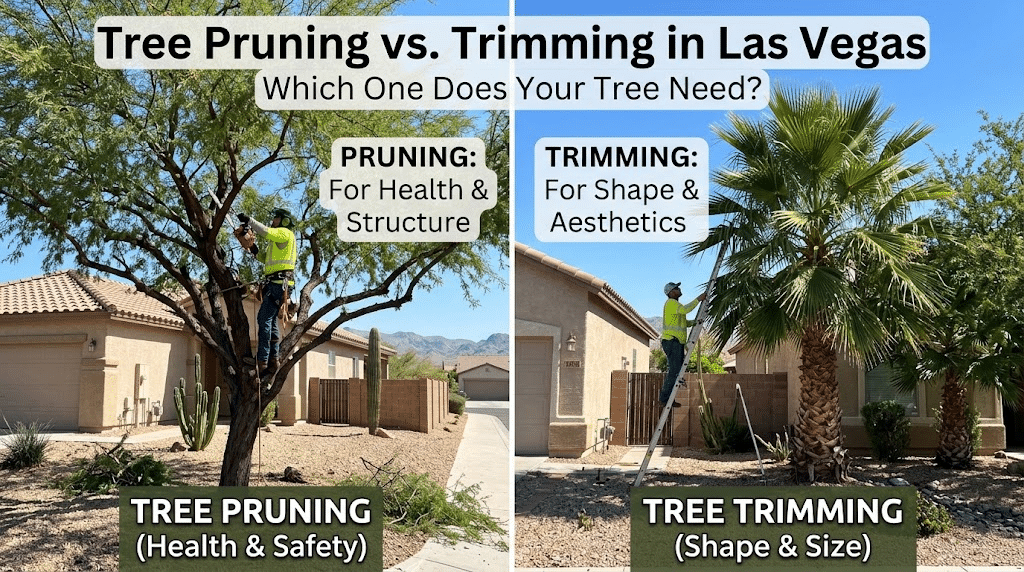
Use this checklist to settle the pruning vs. trimming question for each tree on your property.
Your tree needs pruning if you see:
- Dead, cracked, or hanging branches, or bare limbs during the growing season
- Branches crossing and rubbing against each other
- Two main stems forming a tight V-shaped split
- A dense, heavy canopy on a mesquite or other fast grower heading into monsoon season
- Disease or pest damage on specific limbs
- A young tree past its first year with no clear central structure
- Storm damage of any kind
Your tree only needs trimming if:
- The tree is healthy, but branches touch the roof, walls, or solar panels.
- Palm fronds below horizontal have turned brown, or seed pods are hanging.
- Low limbs block a walkway, driveway, or sight line.
- Your HOA sent a notice about overhang.
- The shape no longer fits the rest of your landscape.
Call for an assessment instead if:
- The trunk leans more than it used to, or soil is lifting at the base.
- You see mushrooms at the base, oozing sap, or large cavities in the trunk.
- More than half the canopy is dead.
- Branches are touching or close to power lines.
Those signs can point to problems that pruning won’t fix, and in some cases the safest option is removal. If you’re weighing that call, here’s how to decide when to remove a tree, with the warning signs explained in detail. If anything is near a power line, keep your distance and contact NV Energy, since that work belongs to their line-clearance crews only.
Pruning vs. Trimming by Tree Type in Las Vegas
Here’s how pruning vs. trimming plays out for the trees we see most in Las Vegas and Henderson yards.
| Tree | What it usually needs | What to watch for | Typical window |
| Mesquite | Yearly thinning, plus trimming for clearance | Dense canopies that split in monsoon wind, suckers, thorns | Late spring, before monsoon |
| Palo verde | Light pruning only | Sunscald on green bark, brown dead branches | Fall, never heavy in summer |
| Desert willow | Light structural pruning | Competing trunks, tangled interior growth | Late fall, after bloom |
| Fan and date palms | Trimming of dead fronds and seed pods | Over-trimmed “hurricane cut” crowns | Late May to June |
| Olive | Thinning plus treatment for fruit and pollen | Dense interior growth, fruit drop on hardscape | Late winter |
| Sweet acacia | Thinning to reduce wind load | Dense, top-heavy canopies that blow over or split in monsoon storms | Late spring, before monsoon |
| Chitalpa | Light structural pruning | Competing trunks, twiggy interior growth, leaf spot in crowded canopies | Late winter, before new growth |
Palms are the one tree where “trimming” is the right word almost every time. A palm grows from a single bud at the top and can’t replace a lost crown, so the job is removing what’s dead, not reshaping. Leave every green frond that sits above an imaginary line from 9 o’clock to 3 o’clock on the crown.
Olive trees in older Las Vegas and Henderson neighborhoods often need both services. Thinning opens the canopy, and pairing it with olive tree spraying in the same late-winter visit cuts down on messy fruit and spring pollen.
Cuts to Refuse, Whatever the Crew Calls It
In any tree pruning vs. trimming decision, some cuts are off the table. Several of the most common ones in the valley do lasting damage, so turn them down even if the price is right:
- Topping: cutting main stems back to stubs. The tree answers with fast, weakly attached sprouts and decay at every cut.
- Lion-tailing: stripping all interior branches and leaving foliage only at the tips. It’s common on mesquite and palo verde, and it pushes weight to the ends of limbs, exposes bark to sun, and raises breakage risk in wind.
- Hurricane cuts on palms: removing nearly all green fronds. The palm loses its food supply and weakens.
- Flush cuts and stubs: a proper cut sits just outside the branch collar. Cutting into the collar or leaving a stub both invite decay.
- Removing too much at once: a widely used guideline is no more than about 25 percent of the live canopy in a year, and less for stressed or sun-sensitive trees.
One more thing to skip: wound paint. Healthy trees seal their own cuts, and coatings can trap moisture that encourages decay.
Does Pruning Cost More Than Trimming?
Per visit, usually yes. Pruning takes longer because each cut is chosen individually, and larger trees may need climbing or rigging. Trimming a healthy tree for clearance moves faster.
When homeowners compare tree trimming vs. pruning quotes, the lower quote isn’t always the cheaper choice over time. Good pruning means fewer emergency calls after storms, less regrowth to cut back each year, and fewer removals. Tree size, species, access, and condition drive the final price on both.
FAQs
Is tree trimming the same as pruning?
Not quite. Both remove branches, but pruning targets specific branches for health and structure, while trimming controls size and clearance. Arborists often use “pruning” for both, so ask any crew what the goal of each cut is.
Can I prune my own trees?
Yes, for small branches you can reach from the ground with hand pruners or a pole saw. Leave anything that needs a ladder, a chainsaw, or climbing to a professional, including large mesquite and tall palms. Work near power lines belongs to NV Energy’s line-clearance crews only.
How much of a tree can be removed at once?
As a general guideline, no more than about 25 percent of the live canopy in one year, and less for stressed trees or sun-sensitive species like palo verde. Removing more forces heavy regrowth and exposes bark to sunscald.
Do palm trees need pruning or trimming?
Trimming. Remove dead fronds, seed pods, and fruit stalks, and leave green fronds above the 9 o’clock and 3 o’clock line. Over-trimming weakens the palm and makes it more vulnerable to wind.
Does pruning help trees survive the monsoon season?
Yes, if it’s thinning done before storm season. Removing select interior branches lets wind pass through the canopy and lowers the load on each limb. Schedule it for late spring so cuts can begin to seal before the July storms arrive.